WorldClaw looks absurd at first. A Trump linked AI API router, USD1 payment, WLFI lockup, Mar a Lago raffle, and 300 plus models in one hub. But behind the circus, there is a serious signal: AI API aggregation is no longer a niche workaround. It is becoming infrastructure.
Why did this story go viral?
The funny part is easy to understand.
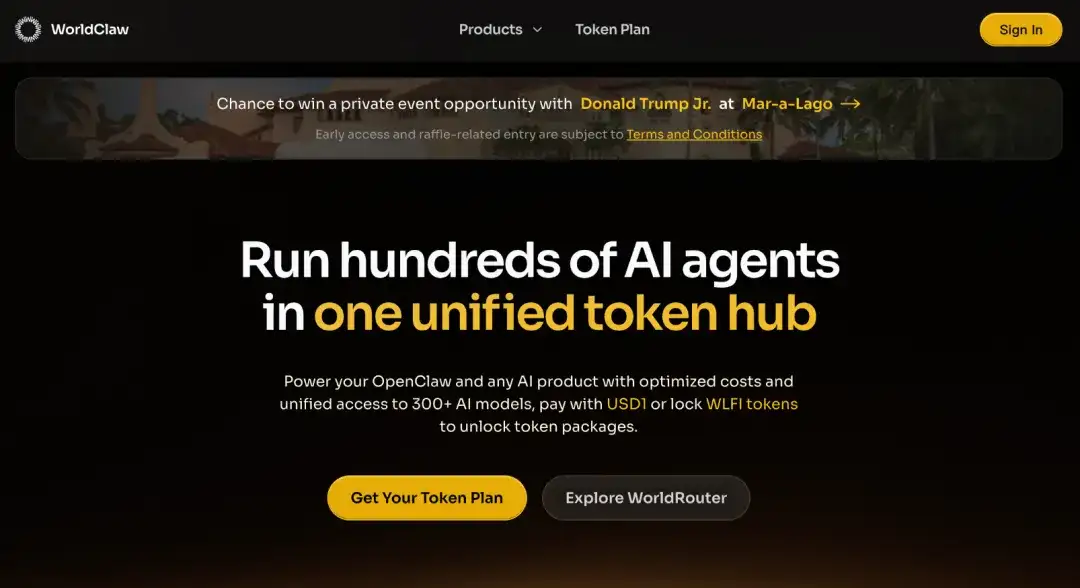
The Trump family entered the AI API router business through WorldClaw. The platform is described as an OpenRouter like service with access to more than 300 models, including Claude Opus 4.7, GPT 5.5, Gemini 3.1 Pro, and Qwen models. The screenshots show a repeated 30 percent off message across major models.
The surreal part is not the discount.
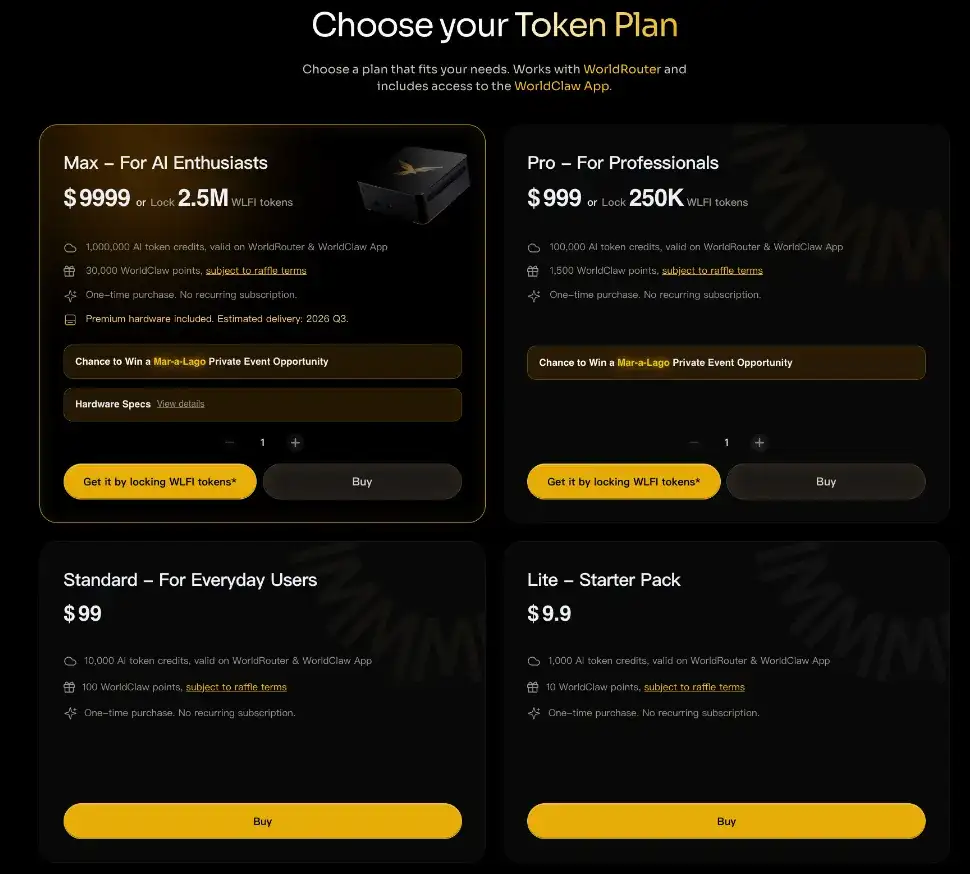
The surreal part is the packaging. WorldClaw is not just selling API credits. It connects the product to USD1 payment, WLFI token lockup, premium hardware, and a chance to attend a private event at Mar a Lago. The Max plan is listed at $9,999, with 1 million AI credits, a hardware device, and raffle eligibility.
This is why people laughed first. It feels like someone took OpenRouter, a crypto launchpad, a campaign fundraiser, and a luxury club membership, then shook them inside the same box.
But that is exactly why the story matters.
A normal developer sees API routing. A crypto user sees token utility. A political supporter sees access. A marketer sees a funnel. A founder sees a distribution machine.
That mix is ridiculous. It is also effective.
What is WorldClaw really selling?
WorldClaw is not only selling cheaper inference.
It is selling five layers at once.
| Layer | What users see | What the business captures |
|---|---|---|
| API routing | One hub for hundreds of models | Call margin and user traffic |
| Discount pricing | 30 percent off major models | Prepaid demand and lock in |
| USD1 payment | Pay through a branded stablecoin | Payment flow and stablecoin usage |
| WLFI lockup | Lock tokens for top tiers | Token demand and ecosystem activity |
| Mar a Lago raffle | Private event access | Political brand premium |
| Hardware | Local AI device bundle | Device margin and future lock in |
WorldClaw’s public materials describe USD1 payment and WLFI lockup as part of its top tier access design. In plain English, the user first enters the token system, then consumes API credits.
The business model is more layered than a normal API router. A standard router mostly earns from call margin, while WorldClaw can capture call margin, stablecoin flow, token lockup demand, political IP premium, and hardware sales.
In short, WorldClaw is not just an API router. It is a token economy with API demand attached to it.
That sentence may sound harsh. But it is the cleanest way to understand the product.
Why would Trump’s family enter an API router business?
Because API routing is no longer a tiny developer tool.
Many people still think API routers are gray market patches for users who cannot access GPT or Claude directly. That was partly true in the early stage. Some users needed a workaround for account restrictions, regional payment problems, credit card issues, or provider bans.
But the market is moving beyond that.
The more models there are, the more necessary routers become. Each model has different strengths, each provider has different risk controls, each payment channel behaves differently, and compute is unevenly distributed. A router can help users manage accounts, unified billing, and model routing.
That is the real reason this story matters.
When the model market becomes fragmented, the router becomes the new control panel.
Think about travel booking. At first, people booked flights directly with airlines. Then the market got messy. Prices changed, routes changed, policies changed, and users needed Expedia or Google Flights to compare and choose. AI models are heading in the same direction.
No serious team wants to open ten provider dashboards every morning.
No finance team wants ten invoices with ten different pricing rules.
No developer wants to rewrite integration code every time one model gets cheaper, slower, or blocked.
So the router becomes useful. Not because users are lazy. Because the market is fragmented.
The real API battle is not only about cheap tokens
WorldClaw’s discount is loud. But cheap tokens are only one part of the game.
The deeper API battle is about control.
| User need | What a router solves |
|---|---|
| Model coverage | Access more models through one account |
| Cost control | Compare prices and avoid using premium models for simple tasks |
| Reliability | Switch when one provider is unstable |
| Payment friction | Use one billing flow instead of many |
| Team management | Track usage by key, model, project, or user |
| Scale | Route traffic across models and providers |
This is where I think many people misunderstand the API router business.
A router is not valuable because it is a middleman. A router is valuable when the model market becomes too messy for users to manage directly.
The middleman that only marks up traffic will eventually be squeezed. The middleman that gives control, transparency, routing, fallback, and billing clarity can become infrastructure.
That is the difference between a toll booth and a traffic control tower.
A toll booth just charges you.
A traffic control tower tells planes where to land, when to wait, and how to avoid crashing into each other.
AI teams increasingly need the second one.
Why the crypto part feels both clever and dangerous
I will be honest. The USD1 and WLFI angle is clever, but it also makes the product feel less clean.
If the goal is simply to help developers call models, crypto payment adds friction. If the goal is to create real utility for USD1 and WLFI, then AI usage is a smart move. AI agents can generate many small transactions. API calls are frequent, measurable, and easy to attach to a token economy.
That is why this move is smarter than it looks.
A speculative token always needs a story. A stablecoin always needs flow. An AI agent economy can provide both.
But the danger is obvious. Once a router is tied to token lockups, raffles, and political access, users have to ask a harder question.
Am I buying infrastructure, or am I being pulled into someone else’s liquidity machine?
That question matters more than the 30 percent discount.
A cheap API is not cheap if it makes your payment path complicated, your risk unclear, or your production stack dependent on a celebrity brand cycle.
What developers should learn from this
Developers should not laugh and move on.
The lesson is bigger than WorldClaw.
API routers are becoming normal because the AI market is becoming too complicated. A useful way to read this market is that WorldClaw, BAI, and EasyRouter are not the same species. WorldClaw mixes package plans and brand activities, BAI uses subscription pricing with limited transparency, and EasyRouter looks closer to token based transparent billing.
That framing is useful. The next API market will not have one type of router. It will have several.
| Router type | Main appeal | Main risk |
|---|---|---|
| Discount router | Lower token cost | Weak stability or hidden limits |
| Subscription router | Predictable monthly price | Unclear message or token limits |
| Enterprise router | Governance and reliability | Higher requirements for onboarding |
| Crypto router | Token flow and community energy | Payment risk and speculation |
| Hardware linked router | Local workflow lock in | Device dependency and switching cost |
The API router market is splitting the same way cloud did. Some players sell cheap compute. Some sell enterprise reliability. Some sell ecosystem lock in. Some sell a story.
WorldClaw sells all four at once. That is why it feels loud.
Why this is bigger than one Trump branded launch
The real question is not whether WorldClaw is good.
The real question is why a political brand wants to own the API layer.
My answer is simple: whoever owns the API layer owns the transaction layer of AI work.
If agents become mainstream, they will not just chat. They will call models, search, write code, generate images, trigger tools, pay for actions, and renew subscriptions. Each step can become a small transaction. Each transaction needs routing, billing, limits, authentication, logs, and fallback.
This is the future WorldClaw is betting on.
Today, a $9,999 package looks like a meme.
Five years later, the real money may come from millions of agent calls that automatically route, pay, retry, and settle.
The API layer is where intelligence becomes consumption. That is why everyone suddenly wants to stand there.
The bigger signal behind the noise
I do not think users should judge this only by whether Trump’s family is involved.
That makes the story fun, but it can also distract from the real point.
- WorldClaw is not really built for ordinary developers. The $9,999 plan, USD1 flow, WLFI lockup, and Mar a Lago raffle look more aligned with crypto whales, political supporters, and brand driven buyers than with someone who just wants Claude for coding.
- The router market is real. Model fragmentation, pricing changes, provider limits, and agent workloads make unified access more valuable every month.
- The next fight is trust. Cheap calls are easy to advertise. Transparent billing, stable routing, fast support, and clean key management are harder to fake.
- The worst API products will sell hype. The best ones will quietly reduce friction.
This is the part I care about most.
API infrastructure should feel boring in a good way. It should not make you wonder whether you are buying compute, joining a club, pumping a token, or entering a raffle.
A good API layer should be like plumbing. You only notice it when it breaks.
Maybe you know WorldClaw now. You should know PP API too.
WorldClaw made the API router race louder. But loud is not the same as useful.
A serious team needs fewer gimmicks and more control. For teams that want the useful part of API routing without the noise, PP API is worth looking at.
PP API is a unified large language model API platform. It lets teams access models from OpenAI, Anthropic, Google, DeepSeek, Alibaba, and other providers through one interface. It uses a compatible format, so teams can switch providers by changing the model name. It supports smart routing, multi provider failover, pay as you go billing, no subscription fee, transparent model price comparison, OpenAI SDK compatibility, and enterprise support.
For developers, PP API’s Quick Start says the platform is compatible with OpenAI Chat Completions. Developers only need to point the base URL to PP API and use a PP API key. The same guide shows that switching models only requires changing the model parameter, such as moving from GPT to DeepSeek, Qwen, or Gemini.
For teams, PP API gives a more practical control layer. Token Management lets users create, edit, enable, disable, and delete API keys, set independent quota limits, and apply model restrictions.
If WorldClaw shows that API routing is becoming a hot business, PP API shows what a practical API layer should care about: model access, cost visibility, failover, quota control, and developer migration.
That is less flashy than a Mar a Lago raffle.
But for a team shipping real products, boring is a feature.
FAQs
What is WorldClaw?
WorldClaw is described as an AI API router similar to OpenRouter. It claims access to more than 300 models, including Claude, GPT, Gemini, and Qwen models, with major models marked as 30 percent off in screenshots.
Why is the Trump family entering the API router market?
The move suggests that API routing is becoming valuable infrastructure. A router can sit between users and many model providers, handling access, billing, model choice, and potentially payment flow. That layer becomes more important as AI agents and model fragmentation grow.
Is WorldClaw just a cheap API platform?
No. WorldClaw also includes USD1 payment, WLFI token lockup, premium hardware, and a private event raffle tied to Mar a Lago.
What should users check before choosing an API router?
Users should check model coverage, billing transparency, provider stability, routing capability, customer support, key security, quota controls, and whether the platform creates unnecessary payment or lock in risk.
How is PP API different from hype driven routers?
PP API focuses on practical API access and management. It offers one API for multiple model providers, smart routing, multi provider failover, pay as you go billing, model price comparison, OpenAI SDK compatibility, API key quota control, dashboards, and usage logs.